Key Takeaways
Learn how to tell whether a blank or unresponsive thermostat or a furnace problem is behind weak heat. You'll get a 10-minute test that checks batteries, settings, airflow and temperature readings, plus clear signs that point to the thermostat or the furnace. The guide also covers when to stop troubleshooting, including gas smells, carbon monoxide alarms, soot or yellow flames, and why catching trouble before a Dallas-Fort Worth cold snap beats waiting for a busy repair day. Call (214) 340-4999 if you want both tested.
Short answer: If your thermostat screen is blank, reads the wrong temperature, or doesn’t click when you raise the setting, the thermostat is the likely problem. If the thermostat responds normally but the furnace short cycles, runs nonstop, or blows cool air, the problem is usually inside the furnace itself. A simple 10-minute test (below) can narrow it down before you call for service.
November in Dallas-Fort Worth is unpredictable. One week it’s 78°F, the next a cold front drops overnight lows into the 30s, and the heat you barely used last week suddenly has to carry the house. That’s when small problems show up: rooms that never feel warm, a furnace that kicks on and off every few minutes, or a thermostat that seems to ignore you.
Chapman Air & Heat has been fixing heating systems across DFW since 1981, and one of the most common questions we hear this time of year is simple: “Is it the thermostat or the furnace?” Here’s how to tell.
How the Thermostat and Furnace Work Together
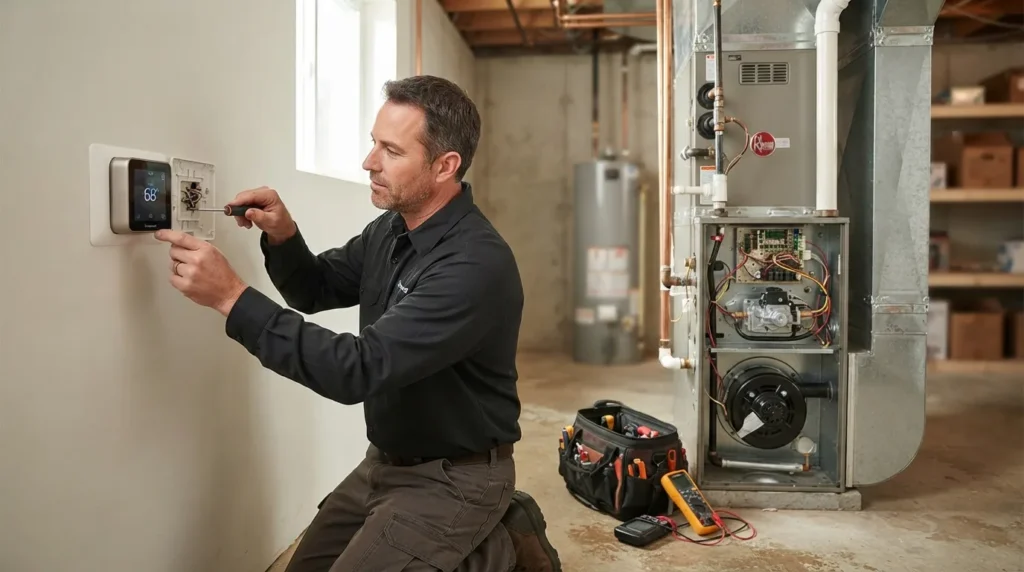
Your thermostat is the control center. It measures the room temperature and sends a low-voltage signal to the furnace when heat is needed. The furnace does the actual work: it lights the burners, warms the heat exchanger, and runs the blower to push warm air through your ducts.
When something goes wrong, the problem is either in the signal (the thermostat or its wiring) or the response (the furnace). Figuring out which side is failing saves time, money, and a lot of guesswork.
Signs the Problem Is Your Thermostat
Your thermostat is likely the culprit if you notice:
- A blank or dim screen. Usually dead batteries, a tripped breaker, or a loose wire.
- The reading doesn’t match the room. If the thermostat says 70°F but the house feels like 64°F, it may be miscalibrated or poorly placed.
- No click when you change the setting. Most thermostats make an audible click when they call for heat. Silence can point to a failed relay or wiring problem.
- Settings that reset or won’t hold. Schedules disappearing or temperatures changing on their own often mean an aging or faulty unit.
- Short cycling caused by placement. A thermostat in direct sunlight, next to a lamp, above a supply vent, or near a drafty door gets false readings and shuts the heat off too early (or keeps it running too long).
- The wrong system setting. Smart and programmable thermostats can be configured for a heat pump when you have a gas furnace, or vice versa. This often happens after a DIY install or a power outage.
Signs the Problem Is Your Furnace
If the thermostat is responding normally, look at the furnace. Common signs include:
- The burners light, then shut off within seconds. This often points to a dirty or failing flame sensor.
- Short cycling with a normal thermostat. A furnace that overheats (often from a clogged filter or blocked vents) trips its high-limit switch and shuts down to protect itself, then restarts once it cools.
- The blower runs, but the air is cool. Possible ignition, gas supply, or burner issues.
- The furnace runs constantly but the house never reaches the set temperature. Dirty filters, leaky ductwork, a failing component, or a system that’s undersized for the home.
- Unusual noises. Banging, grinding, squealing, or repeated clicking without ignition all need a technician’s attention.
- Yellow or flickering burner flames, or soot near the furnace. These can signal a combustion problem and should be checked right away.
A Simple 10-Minute Test to Narrow It Down
Try these steps before you call. They won’t fix every problem, but they’ll tell you (and your technician) a lot.
- Replace the thermostat batteries if it uses them, even if the screen looks fine.
- Check the mode and setting. Set it to Heat and raise the temperature 3 to 5 degrees above the current room temperature.
- Listen for a click at the thermostat, then listen for the furnace to start within a minute or two.
- Switch the fan from Auto to On. If the blower starts, the thermostat is communicating with your system. If nothing happens, check the breaker and the furnace power switch (it looks like a light switch near the unit).
- Compare temperatures. Place a separate household thermometer near the thermostat for 15 minutes. A difference of more than 2 to 3 degrees suggests a calibration or placement issue.
- Check the air filter. A clogged filter is one of the most common causes of short cycling and weak heat.
What the results mean: If the thermostat doesn’t respond to any of these steps, the thermostat or its wiring is the likely problem. If it responds normally but the heat still isn’t right, the furnace needs a professional diagnosis.
If your furnace won’t start at all, our guide on what to do if your furnace won’t turn on walks through the next checks.
When to Stop Troubleshooting and Call a Pro
Call a licensed HVAC technician if:
- The breaker trips again after you reset it
- The furnace short cycles even with a clean filter and a correctly set thermostat
- You hear clicking but the burners never light
- The house can’t get warmer than a few degrees below your setting
- You see soot, scorch marks, or yellow burner flames
- The thermostat wiring looks loose, burned, or damaged
Safety first: If you smell rotten eggs or gas, leave the house and call your gas company from outside. If your carbon monoxide alarm sounds, get everyone out and call 911. Don’t try to diagnose these yourself.
Why This Matters Before a DFW Cold Snap
North Texas furnaces sit idle for most of the year, then get pushed hard when a cold front arrives. Problems that were hidden all summer, like a dirty flame sensor, a weak igniter, or an old thermostat losing calibration, tend to show up on the first cold night. That’s also when HVAC calls spike across the metro.
Catching the issue in November, on a mild afternoon, is far easier than waiting for a hard freeze when every technician in Dallas-Fort Worth is booked. If your thermostat is more than 10 years old or keeps giving you trouble, it may also be time for an upgrade. Chapman installs programmable and smart thermostats that can make your heating schedule easier to manage and help trim energy use.
Frequently Asked Questions
Can a bad thermostat cause a furnace to short cycle? Yes. A thermostat placed near a heat source, a draft, or direct sunlight can read the room incorrectly and shut the furnace off too soon. Incorrect cycle-rate settings on some digital thermostats can cause the same problem.
How do I know if my thermostat is reading the wrong temperature? Place a separate thermometer next to it for about 15 minutes. If the readings differ by more than 2 to 3 degrees, the thermostat may need recalibration, relocation, or replacement.
Why does my furnace turn on, then shut off after a few seconds? The most common cause is a dirty flame sensor. When the sensor can’t confirm the flame, the furnace shuts off the gas as a safety measure. A technician can clean or replace it quickly.
Should I replace my thermostat myself? Simple battery-powered models are DIY-friendly for many homeowners. Smart thermostats often require a C-wire and correct system configuration, and a wrong setting can cause heating problems. Professional installation ensures it works with your specific furnace or heat pump.
How long should a furnace run per cycle? In mild weather, a properly sized furnace typically runs about 10 to 15 minutes per cycle, two to three times per hour. Cycles much shorter than that, or nonstop running in mild weather, are worth having checked.
Heating Repair Across Dallas-Fort Worth
Chapman Air & Heat provides furnace repair, thermostat installation, and heating maintenance throughout DFW, with trained, certified technicians and 24/7 emergency service for no-heat calls. We regularly serve homes in Dallas, Fort Worth, Plano, Frisco, Allen, McKinney, Richardson, Carrollton, Addison, Farmers Branch, Lewisville, Coppell, Grapevine, Southlake, Garland, Mesquite, Rowlett, Rockwall, Highland Park, and University Park.
Get Your Heat Working Right Before the Next Cold Front
Not sure whether it’s the thermostat or the furnace? You don’t have to guess. Our technicians can test both, find the real cause, and fix it, often in a single visit.
Call Chapman Air & Heat at (214) 340-4999 to schedule a heating check, or visit chapmanair.com to see current coupons and ask about a maintenance plan that keeps your furnace and AC checked every year.